
Retention Filters in general
Several concepts, products, manufactures exist for upstream cell retention purposes. The use of mammalian cell lines for expression of mAbs is huge and in general serving the same purpose - lower the cost of product. Two methods are well established:
- Alternating Flow Filtration (AFF) involves broth alternating along the surface of the membrane.
- Tangential Flow Filtration (TFF) involves one direction flow of the broth along the surface of the membrane.
Cross-Flow-Filter (CFF) is a broad covering technology involving a porous membrane, which allow selectable components under some pressure difference to pass from one liquid volume into another liquid volume crossing the membrane, the porous barrier restricting desired components from passing through the membrane.
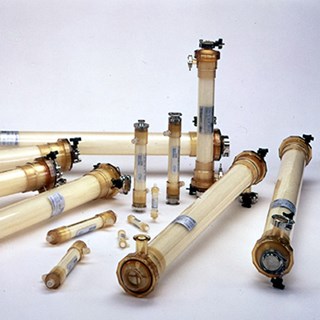
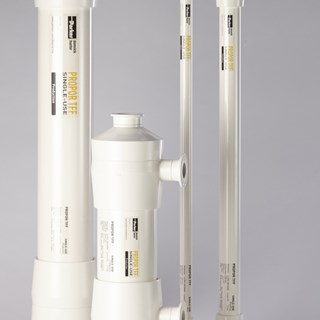
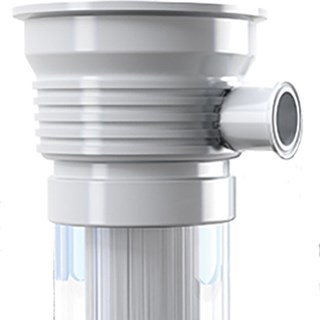
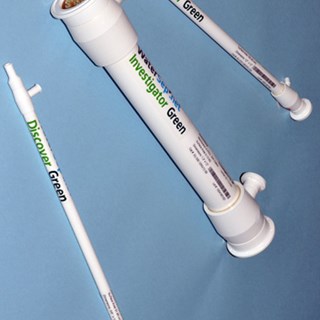
Hollow-Fiber-Filter (HFF) modules is a popular membrane product based on multiple of in parallel arranged extruded hollow porous straw, lumen arranged inside a plastic tube creating the cartridge. A pump force broth flow inside and along the porous wall lumen from broth inlet to HFF outlet as retentate. Product harvest is transverse through, allowed to pass the lumen wall as permeate.
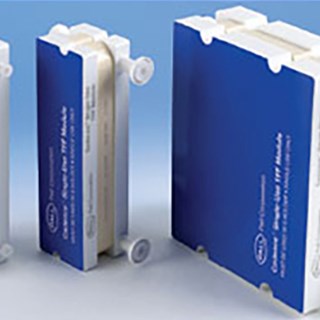
Plate-and-Frame systems accommodates flat sheet porous membranes arranged in stacked compartments. In general low packing density, low efficiency compared to other configurations, higher pressure drop, difficult to keep clean are other problems associated with Plate-and-Frame systems.
Two important measures, parameters are: DeltaP / ∆P – (Pressure-Drop) and the Trans-Membrane-Pressure (TMP). Forces that drives liquid along the HFF surface and across/through the membrane. During filtration, the feed, broth side of the membrane is under pressure higher than the permeate side. This pressure difference forces liquids and the desired particles, proteins to pass through the membrane and those particles larger than the pores not to pass exciting via retentate outlet.