

Retention Filters in general
Several concepts, products, manufactures exist for upstream cell retention purposes. The use of mammalian cell lines for expression of mAbs is huge and in general serving the same purpose - lower the cost of product. Two methods are well established:
- Alternating Flow Filtration (AFF) involves broth alternating along the surface of the membrane.
- Tangential Flow Filtration (TFF) involves one direction flow of the broth along the surface of the membrane.
Cross-Flow-Filter (CFF) is a broad covering technology involving a porous membrane, which allow selectable components under some pressure difference to pass from one liquid volume into another liquid volume crossing the membrane, the porous barrier restricting other components from passing the membrane.
Hollow-Fiber-Filter (HFF) modules is a popular membrane product based on multiple of in parallel arranged extruded hollow straw, lumen arranged inside a plastic tube creating the cartridge. A pump force broth flow inside and along the porous wall lumen from inlet to outlet. Product harvest is transverse to the lumen wall.
Plate-and-Frame systems accommodates flat sheet porous membranes arranged in stacked compartments. In general low packing density, low efficiency compared to other configurations, higher pressure drop, difficult to keep clean are other problems associated with Plate-and-Frame systems.
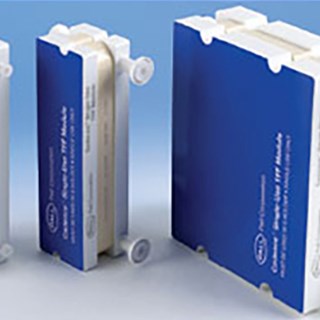
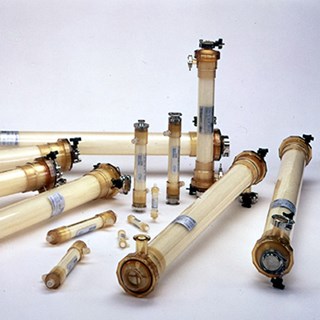
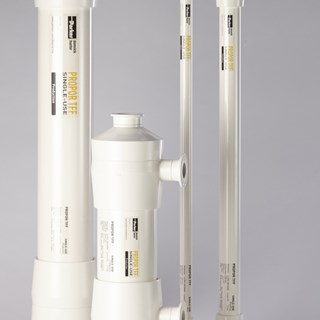
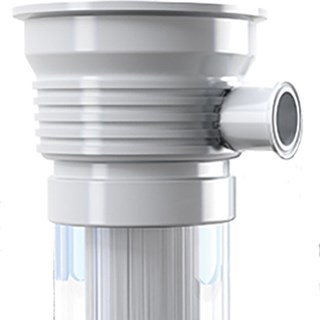
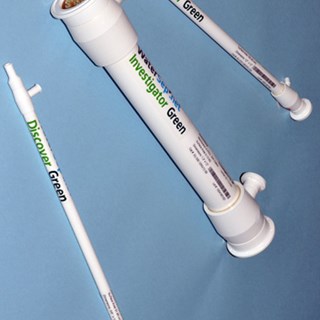
Two important measures, parameters are: DeltaP / ∆P – (Pressure-Drop) and the Trans-Membrane-Pressure (TMP). Forces that drives liquid along the HFF surface and across/through the membrane. During filtration, the feed, broth side of the membrane is under pressure higher than the permeate side. This pressure difference forces liquids and the desired particles, proteins to pass through the membrane and those particles larger than the pores not to pass exciting via retentate outlet.
TMP - (Trans-Membrane-Pressure) is the difference between the average upstream, feedstock inlet pressure and permeate pressure after the Cross-Flow-Filter membrane. The pressure difference across the filter membrane = TMP is the driving force for membrane flux = harvest. TMP will increase between Cleaning Cycles as a function of the severe fouling increase.
TMP is the net pressure that forces the part of the broth to become permeate through the membrane and is typically calculated as the average of the inlet and outlet pressures minus the permeate pressure. The equation is generally expressed as:
TMP = (P_in + P_out) / 2 ÷ P permeate
Several factors influence both TMP and pressure drop, impacting how they interrelate. In membrane filtration, membrane fouling is a significant factor that increases TMP over time. Fouling occurs when particles, colloidal materials, or biological substances accumulate on the membrane surface, increasing resistance to flow. This can lead to a higher TMP as more pressure is required to achieve the same harvest flow rate.
TMP refers to Trans-Membrane-Pressure. TMP is the driving pressure difference that moves liquid and low molecular weight solute through the membrane. When controlling a filtration process with TMP control, pressure is regulated, controlled at both the feedstock inlet and retentate exit port, and flux (flow through the membrane) is governed by porosity, pore size, surface area, broth viscosity, solute concentration, concentration polarization and pressure. In this mode, flux is high at the beginning of the process, but diminishes as a function of time/throughput as to membrane fouling. This fouling is what Clotho / Thalia / Clio is able to remove via the Cleaning Cycles.
DeltaP / ∆P – (Pressure-Drop) is the difference in pressure between two points in a flow system. It reflects the resistance the fluid encounters as it moves through a filter or a series of lumens in parallel. The greater the resistance, the larger the Pressure Drop, which are caused by factors such as the length of the lumen, its diameter, the roughness of its interior surface, possible increased fouling and the viscosity of the fluid.
The pressure increase is the difference between the HFF feedstock inlet and the retentate exit port. Low, close to atmospheric pressure in the broth volume of the SUB. High at the retentate outlet as function of fouling. DeltaP ∆P will increase as a function of the ID of the lumen decreases as to unavoidable fouling. Pressure Drop are affected by the characteristics of the fluid being processed, such as its viscosity and temperature. A higher viscosity fluid, such as containing high biomass levels, will naturally result in a greater pressure drop, as will lower temperatures that increase fluid density and resistance to flow.